TL;DR -- quick answer
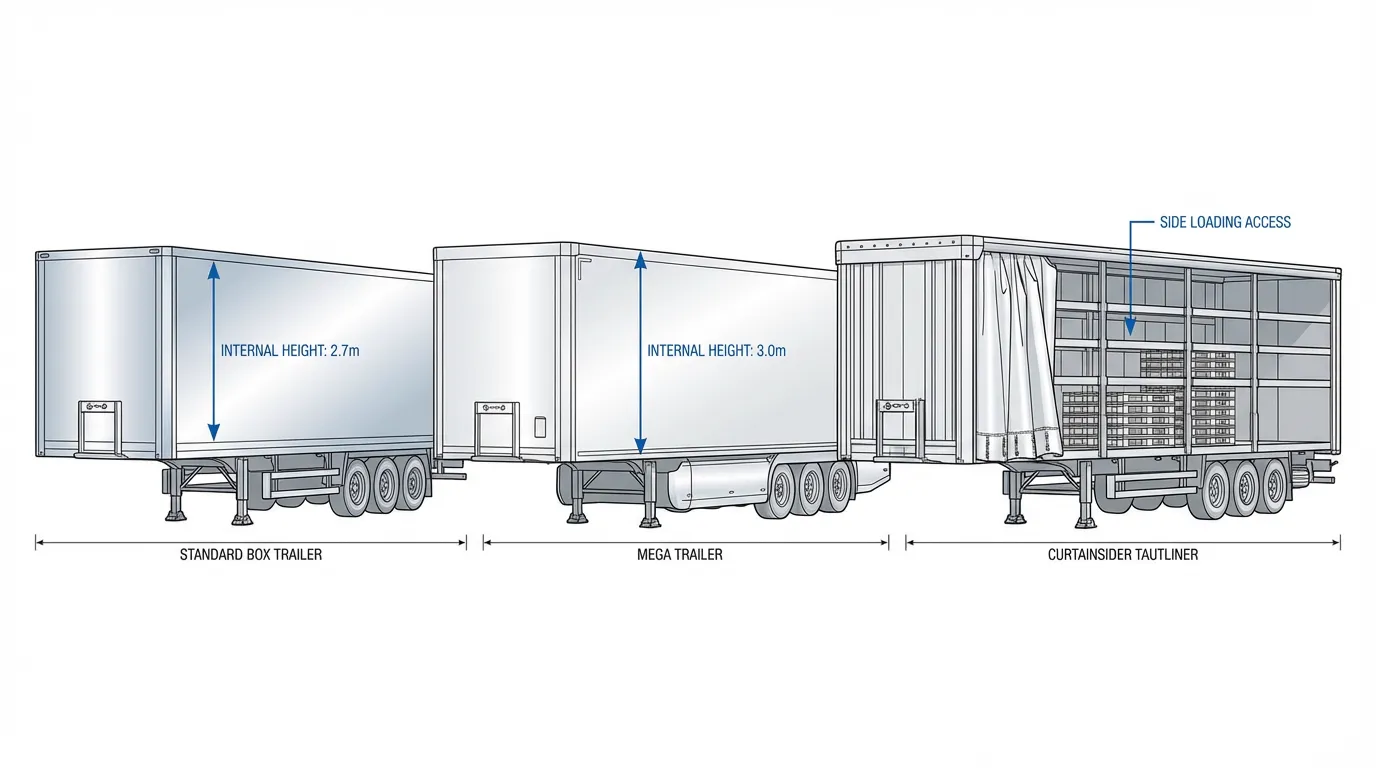
Standard trailer (curtainsider): length 13.6 m, width 2.4 m, internal height 2.6-2.7 m, 33 euro pallets, payload up to 24 t.
Mega: same 13.6 m length and 2.4 m width, but internal height up to 3.0 m (more volume for light, high cargo).
Road limits for the rig: 16.5 m length, 4.0 m total height, 40 t gross weight. Check what fits - LDM calculator.
When a customer asks whether their cargo fits on one truck, the answer is rarely a simple yes or no. The trailer type matters - significantly. The difference between a standard box trailer and a Mega is not just a few centimetres of extra height. It means different loading options, different cargo profiles, and different market rates. Here is what you need to know as a freight forwarder or shipper working with European road transport.
Three trailer types that dominate European road freight
Standard trailer (13.6 m)
The workhorse of European logistics. The standard semi-trailer - sometimes called a "full trailer" or simply a "box" - is the most common vehicle on FTL and groupage routes across Europe. Internal loading length: 13.6 m. Usable width: 2.4 m. Internal height: 2.6 to 2.7 m, depending on the trailer manufacturer and floor construction. In theory it holds 33 Euro pallets in a single layer, though in practice mixed loads often yield 30 to 32 pallets depending on how the cargo is stacked.
The gross vehicle weight of a tractor-trailer combination in Europe is capped at 40 tonnes, leaving a net payload of up to 24 tonnes depending on the tare weight of the specific unit. On Scandinavian and Baltic routes higher GVW limits apply (up to 68 t with multiple axles), but that is a separate subject.
Mega / Jumbo trailer
The Mega trailer - also called a Jumbo or lowliner - uses a lowered floor to achieve an internal loading height of 3.0 m, sometimes 3.05 m. Length and width remain the same as standard: 13.6 m and 2.4 m. The extra headroom means palletised cargo reaching 220 to 240 cm total height can be transported where it simply would not fit in a standard trailer.
Mega trailers are particularly popular for volumetric goods - light cargo that fills space before it reaches the weight limit. Household appliances, furniture in flat-pack boxes, empty packaging, and insulation materials are typical examples. Mega rates are usually 5 to 15% above standard, reflecting lower vehicle availability and higher purchase cost.
Curtainsider (Tautliner)
The curtainsider has flexible fabric sides and a rigid roof. Internal dimensions are identical or very close to a standard trailer (13.6 m length, 2.4 m width, 2.6 to 2.7 m height). The defining feature is side loading access - both sides can be opened simultaneously. This makes a curtainsider essential whenever cargo must be loaded or unloaded by forklift from the side, or when items are too wide to pass through the rear doors.
Curtainsiders dominate groupage transport, steel products, building materials, and any cargo where side access is a requirement rather than a preference. In Germany and Poland they are the most frequently ordered trailer type for both FTL and LTL.
Trailer comparison table
| Parameter | Standard | Mega / Jumbo | Curtainsider |
|---|---|---|---|
| Internal length | 13.6 m | 13.6 m | 13.6 m |
| Usable width | 2.4 m | 2.4 m | 2.4 m |
| Internal height | 2.6-2.7 m | 3.0-3.05 m | 2.6-2.7 m |
| Volume | approx. 82-88 m³ | approx. 98-100 m³ | approx. 82-88 m³ |
| Max payload | up to 24 t | 22-24 t | up to 24 t |
| Max Euro pallets (single layer) | 33 pcs | 33 pcs | 33 pcs |
| Side loading | Yes | Yes | Yes |
| Max LDM | 13.6 LDM | 13.6 LDM | 13.6 LDM |
Which trailer type to choose - and when
Standard - when to use it
The standard trailer works for the vast majority of FTL and LTL shipments. If your cargo fits within 270 cm total height (pallet included), has normal density, and you are booking at standard market rates - use a standard trailer. Availability is highest, lead times for vehicle placement are shortest.
Mega - when to use it
- Volumetric cargo: empty packaging, polystyrene, mattresses, flat-pack furniture
- Pallets with total height exceeding 200 to 270 cm
- Loads where volume is exhausted before the weight limit is reached
- Double-deck loading where the combined height of two layers exceeds 2.7 m
Curtainsider - when to use it
- Loading or unloading exclusively by side forklift
- Oversized items that will not pass through rear doors (wider than approx. 2.2 m)
- Steel profiles, pipes, construction materials loaded from the side
- Multiple delivery points requiring lateral access
Road limit considerations
Regardless of trailer type, the full combination must comply with European road limits. Standard rules: total length up to 16.5 m, width up to 2.55 m (2.6 m for insulated trailers), height up to 4.0 m. Any cargo exceeding these dimensions requires a special permit for abnormal transport - different rates, mandatory route planning, and potentially escort vehicles.
Also keep axle load in mind: if the cargo mass approaches 24 t, check how the weight is distributed. Uneven loading can breach axle limits even when total mass is below the legal maximum.
Practical tips for quoting
When booking freight, always provide three things: dimensions (L x W x H), gross weight, and packaging type. Without this data every carrier will add a safety margin to their quote - meaning you pay more. The more accurate your information, the better the offer you will receive.
If your cargo is borderline between standard and Mega, ask the carrier about Mega availability on that lane. On busy routes (PL-DE, PL-IT, DE-FR) Mega trailers are usually available same-day. On eastern European or Scandinavian lanes the waiting time can be longer.
Common mistakes when checking trailer fit
The first mistake is using external trailer dimensions instead of internal loading space. A semi-trailer may be described as 13.6 m long, but the usable loading length, door opening, roof shape and floor construction decide whether the cargo actually fits. Always ask for internal dimensions when the load is close to the limit.
The second mistake is checking pallets only by footprint. Thirty-three Euro pallets fit on the floor, but that does not mean the shipment is safe to book as a standard FTL. Pallet height, stacking rules, overhang, packaging strength and weight distribution can change the trailer choice. A tall but light load may need Mega. A short but heavy load may need an axle-load check.
The third mistake is ignoring loading method. Rear loading, side loading and crane loading are different operations. If a forklift must load from the side, book a curtainsider or tautliner. If cargo is too wide for the rear doors, rear loading may be impossible even when the cargo fits inside the body on paper.
Practical rule: cargo above 270 cm total height - always ask about Mega. Cargo requiring side loading - curtainsider, tautliner, jumbo
Frequently asked questions about trailer dimensions
What is the length of a standard trailer?
The internal loading length of a standard trailer (curtainsider) and a Mega trailer is 13.6 m. The total length of the tractor plus trailer rig is limited by regulation to 16.5 m.
What is the width of a standard trailer?
The usable internal width of a standard trailer is 2.4 m (2.45 m on some builds). The maximum permitted vehicle width on the road is 2.55 m.
What is the internal height of a standard trailer?
The internal height of a standard curtainsider is 2.6-2.7 m. A Mega trailer has up to 3.0 m inside. Total vehicle height on the road cannot exceed 4.0 m.
How many pallets fit in a trailer?
The floor holds 33 euro pallets (120 x 80 cm) in a single layer. With mixed cargo you typically fit 30-32 in practice.
What is the payload of a standard trailer?
The payload of a standard trailer is usually up to 24 t, with a permitted gross combination weight of 40 t. Exact payload depends on the tare weight of the tractor and trailer.
Get the trailer dimensions table
Save the quick reference for standard, Mega and curtainsider trailers: internal dimensions, 33 euro pallets, payload, volume and when to choose each trailer type.
- 13.6 m trailer dimensions in one table
- Standard vs Mega vs curtainsider comparison
- Checklist for quoting: dimensions, weight, packaging and loading side